

Why Are Time and Synchronization Important?
PDH and SDH telecommunication networks have required stable and accurate frequency synchronization for decades to operate properly. Packet-based networks do not inherently require synchronization for data transmission. However, synchronization is needed for certain applications, such as TDM service emulation and advanced OAM functions, including delay measurement. Power utility substations are a major driver for accurate time synchronization.
Time vs. Frequency Synchronization – What’s the Difference?
Although closely related, time and frequency synchronization serve different purposes:
Time synchronization ensures that devices share the same time and date reference.
For example: 5 September 2026, 16:05:59.123456.
Frequency synchronization ensures that devices operate at the same frequency.
For example: 2.048 MHz vs. 2.048001 MHz.
Even a small frequency difference can cause clocks to drift apart over time.
In short, time synchronization keeps clocks showing the same time, while frequency synchronization keeps them running at the same rate.
PDH and SDH networks have traditionally required accurate frequency synchronization. While packet-based networks do not inherently require synchronization, it is needed for applications such as TDM service emulation and advanced OAM functions, including delay measurement. Today, power utility applications are a major driver for highly accurate synchronization and time and date stamping.
Time Synchronization for Power Utilities
- IEC 61850-based protection, automation and control systems (PACS) require a highly accurate common time reference to align digitized measurements from instrument transformers.
- Wide-area control and monitoring applications based on IEEE C37.118 synchrophasors also require highly accurate time synchronization for participating phasor measurement units (PMUs).
- Traveling wave-based applications, such as fault location detection and time-domain protection, demand time synchronization accuracy better than 1 microsecond.
- Industrial Internet of Things (IIoT) applications in the power sector also require time-synchronized sensor data. Applications such as automated control, system stability analysis and prediction rely on accurately synchronized measurements.
How to Achieve Accurate Time Synchronization
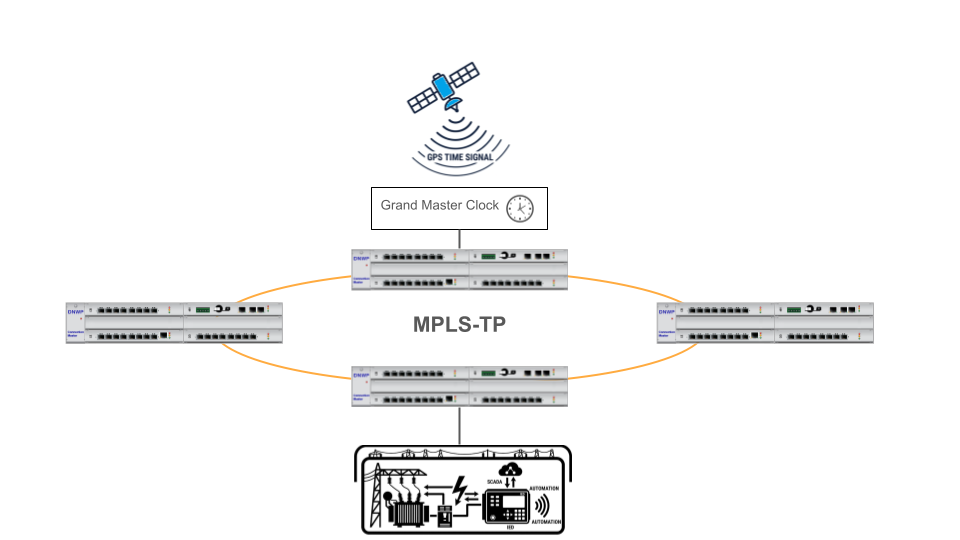
To synchronize large systems, common reference sources are needed. The most commonly used reference sources are satellite-based systems (GNSS). GNSS clocks are cost-efficient and accurate devices for master clocking, but satellite-based receivers have some well-known vulnerabilities.
Common vulnerabilities include GPS jamming and spoofing. For more information and examples of GPS interference, visit gpsjam.org.
To mitigate GNSS-related risks, several solutions are available:
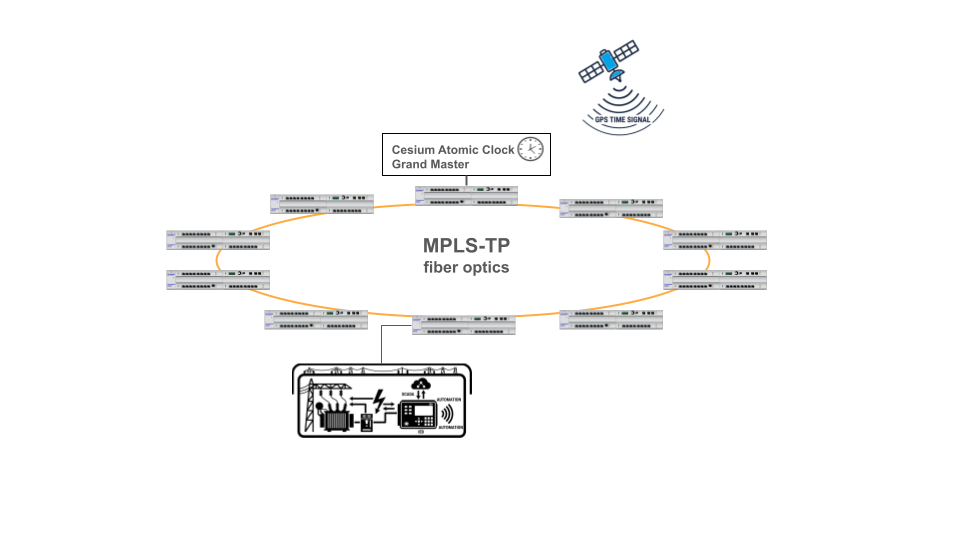
- Cesium atomic clocks provide long-lasting and accurate timing when a reliable satellite signal is unavailable, with holdover accuracy of up to 100 ns over 100 days.
- Fiber optic transmission provides a secure medium for synchronization distribution, either through a dedicated clock network or in combination with an MPLS-TP transport network.
DNWP’s Time and Synchronization Solutions
DNWP provides solutions for accurate and resilient time synchronization in mission-critical utility networks. The solutions cover synchronization sources, PTP distribution and reliable transport of timing information across the network.
Connection Master MPLS-TP – Reliable and deterministic packet transport for critical utility communications, with support for synchronization distribution over the transport network.
Bitstream Quazar System – A timing and synchronization solution for accurate distribution of frequency, phase and time across packet-based networks.
Oscilloquartz – High-accuracy synchronization solutions, including PTP Grandmaster clocks, GNSS references and advanced holdover capabilities for resilient timing architectures.
Together, these technologies enable utilities to build an end-to-end synchronization solution with high accuracy, redundancy and resilience against GNSS failures and disturbances.